Thursday, August 31, 2006

Free Books on Google

If your eyes aren't already glazed over enough from reading text on a computer all day long, you can now add some evening reading to your list with free public-domain books from Google. More information can be found in this CNET News article.

These PDF books can be downloaded and even printed (unlike their other Google Books), depending on the country you're currently in (a factor of the public-domain issue). Obviously, these downloaded books should be for personal use only.

Readers can find the books by choosing the "Full view books" option on the Google Book Search home page before they activate their search. Once they have chosen a book from the results page, a download button is clearly visible on the top-right corner of the page.

Using Google Book Search, you can find The Free Library and many other extraordinary old books, such as:
* Ferriar's The Bibliomania
* A futurist from 1881's 1931: A Glance at the Twentieth Century
* Aesop's Fables
* Shakespeare's Hamlet
* Abbott's Flatland
* Hugo's Marion De Lorme
* Dunant's Eine Erinnerung an Solferino
* Bolívar's Proclamas
* Dante's Inferno

So is this a good thing or not... or neither - just another step in information technology's evolution?

Tuesday, August 22, 2006

Nine is not Enough! (planets, that is)

From NSTA:

Astronomers Debate Definition of Planets; Vote Next Week May Raise Number of Planets From 9 to 12

After two years of work a panel convened by the International Astronomical Union has reached a decision about the definition of "planets" and smaller "solar system bodies" such as comets and asteroids. If the definition is approved this week the number of planets in the Solar System would rise from 9 to 12, with more to come. Read more in the USA Today article and an article from the Boston Globe.


What we consider the information or facts of today, may change as our ways of understanding and observing change or develop (or evolve). Since the beginning of time, technological advancements are deemed responsible for these changes and there is obviously no end in sight to this onslaught.

As you decide what to teach students, be sure to also venture beyond content, into the realm of learning... THEIR learning, once they're no longer in your course. What skills and abilities do you want them to take with them so they can inquire and learn more on their own? Do they know how to go about doing this? (It's dangerous to assume they do.)

Monday, July 17, 2006

Blogging in Science Classroom

The National Science Teacher's Association's (NSTA's) Journal of College Science Teaching, Vol. 35 No. 6, p. 18-22 (May/June 2006) features Blogs - by Erica Brownstein and Robert Klein

It provides definitions, examples and diagrams of blogging for educational purposes as well as rules for an effective blog in a science classroom and grading options.

Mul-TV: How much is too much?

Spoken news briefs, written news briefs, time, weather, box scores, stock quotes, logos and more (oh my)!

How much information can we absorb or consume in one TV sitting? Are our students better at this? Is it something we'll all improve upon with time? Are we going down a "slippery slope"? How much is too much? How effective are we at multitasking?

And the "good news" is that bigger & better screens are on their way into our homes and classrooms!


(from http://www.watchfarscape.com/forums/showthread.php?t=17346)

Defying Distance: Virtual Meeting Spaces, Webinars & Video Chats


In this age of globalization and rapid change where budget and time constraints consistently affect decision-making, professionals in business, government and education are using virtual meeting spaces at an ever-increasing rate. Although not new to the business world in particular, this technology has advanced to a point where it is an viable alternative to face-to-face (F2F) meetings thanks to burgeoning broadband connections and infrastructures.

Some teaching and learning professional development sites, such as the Ohio Learning Network and Learning Times are currently using virtual spaces to deliver services to members and interested parties, thus extending their reach.

While the Blackboard course management system offers similar features such as Chat and Virtual Classroom, these embedded tools haven't been as predictable with continuity and speed. Blackboard also doesn't easily allow for guests outside of the university to enter and participate in the virtual classroom event.

Here are some options for web-based virtual meeting spaces &/or webinars, most fairly expensive (but like every other technology, will soon be plummeting):

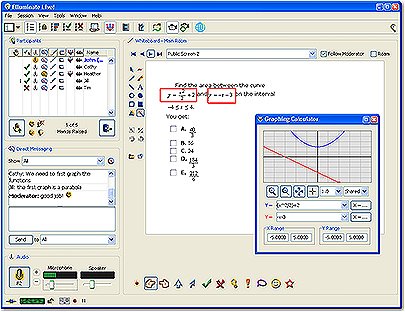
Elluminate - Used by OLN for their TeachU series of online web seminars.

Adobe Breeze - Used by Innovate Online Journal for their webinars. An example of a recorded webinar session is this one: "Uses and Potentials of Wikis in the Classroom"

Microsoft Live Meeting

WebEx

Now for free alternatives: (no... Google does NOT offer a video conferencing option as of today... but it may not be long until Talk does more than instant message!)

Another virtual meeting alternative comes with new Apple computers in iChat or iChatAV. With a built-in camera on all new Apple's, you can video conference realtime with up to 4 locations/people. Here is a link to how it looks and other educational uses for such a product. For those with a slightly older Mac, an iSight camera can be purchased and used along with OS 10.4 (Tiger) to accomplish the same type of communications.

Windows users will soon have an apparently non-video/image based collaboration venue in their upcoming Vista OS. Currently there are 3rd party alternatives available for Windows users wanting video conferencing, such as AOL - AIM and Skype.

One other free, downloadable option for voice or video chats (and short video messages) is SightSpeed. This is discussed in a previous posting on virtual office hours. This is a free Mac and Windows OS alternative.

And a parting thought... It shouldn't be long before we are able to stay home or in our offices and do all our communicating via an internet connection! ;-) "To connect or disconnect?", that is the question!

TeachU: Ohio Learning Network's Online Seminars

The Ohio Learning Network's TeachU Online Seminars are
"a series of free, hour-long interactive Web presentations on uses of emerging technologies and pedagogies within the contexts of teaching, assessment, and student success. Each seminar is delivered live using online audio and video/image presentation technology, allowing you to interact with the presenter(s) and your colleagues through your web browser.

With seminar-specific variations, the facilitator and presenter will discuss the topic and respond to questions submitted by seminar participants in an online meeting room. Generally, the guest will do an initial presentation, using PowerPoint slides, Web tours, or other online resources, and then engage in dialogue with the facilitator and online participants.

These seminars were created to provide Ohio's educators with accessible, timely, and outstanding learning opportunities at no cost. They have been designed to showcase excellence and existing expertise within Ohio's institutions, while providing practical approaches so participants can implement what they learn. All facilitators are sharing their expertise and resources within the TeachU online Seminar Series to benefit all."


Although there are no offerings this summer, suggestions are being considered for the fall semester. A current listing of the past sessions are available in the Archives area. Past, recorded sessions include:

Games, Multi-Player Environments, Immersive Reality: Virtual Worlds & Avatars: What Do They Mean for Learning?

Competency Expectations: E-Portfolios Lead Us Where We Need To Be

Student Success Skills Integration

Chunking Learning: The Why and How of Successful Modularization

Podcasting

Using Concept Mapping and Problem-Based Learning to Encourage Meaningful Learning

Ohio OSPILOT Update (with an emphasis on e-portfolios)

If you've never tried an online interactive webinar, the TeachU sessions provide a great starting point to experience the medium first hand. After creating a free account with Learning Times, you will be able to easily access the online gathering through a link provided to you upon registering. The application used for the webinars is called Elluminate.

More details on the TeachU technical requirements and steps can be viewed here.

Wednesday, July 12, 2006

Learning Community Applications Available

The Center for Teaching, Learning and Technology welcomes BGSU faculty and graduate students to explore our learning community opportunities for the 2006-2007 academic year.

Here is our current offering as of July 4th (click on each to see a description &/or download the application):

Developing a Professional Identity through Mentoring and Eportfolios

Grant Writing

Initiatives for the Future (IF) at Firelands

New Faculty

Publication

Reflective Teaching

Research in Science and Mathematics Education

Research and Teaching

Transition to Digital


Check back by the end of July for our full offering of learning communities for the upcoming year. If you have any questions, please contact the Center at ctlt@bgsu.edu

Thursday, June 29, 2006

Bringing the Classroom to the Student


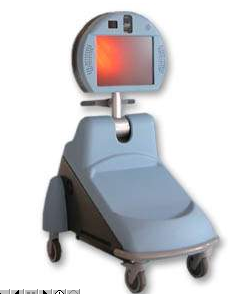
The PEBBLES Project (Providing Education By Bringing Learning Environments to Students) allows students requiring long-term hospital care to continue to engage in classroom learning. This article in eSchoolNews online explains:
The robot in the classroom, which displays a live picture of Achim, provides what its inventors call "telepresence": It gives the boy an actual presence in the classroom, recognized by teachers and classmates. It can move from class to class on its four-wheeled base, and it could even stop at the lockers for a between-periods chat.
"The robot literally is embraced by students in the classroom as though [it] is the medically fragile student," said Andrew Summa, national director of the robot project, which is in use at six other hospitals around the country. Achim's teacher, Bob Langerfield, said his other students have become used to the robot and were treating it as if it were Achim after just a few days.

Although this project is focused currently on K-12 students, it shouldn't be long until there is a push at the post secondary level. How would the presence of "virtual students" affect your course goals & objectives, if at all?

For another perspective on virtual learning, Can e-learning replace classroom learning? (2004), Zhang, Zhao, Zhou and Nunamaker suggest the following regarding e-learning specifically:
Nevertheless, we believe that e-learning is a promising alternative to traditional classroom learning, which is especially beneficial to remote and lifelong learning and training. In many cases, e-learning can significantly complement classroom learning. E-learning will keep growing as an indispensable part of academic and professional education. We should continue to explore how to create more appealing and effective online learning environments. One way to do this is to integrate appropriate pedagogical methods, to enhance system interactivity and personalization, and to better engage learners.

As research in the myriad of other educational technologies continues to grow, we'll need to pay very close attention to the benefits and costs for both students and teachers.

Those that are concerned about emerging technologies such as the internet, course management systems (Blackboard, etc.), podcasting/ videocasting and gaming changing the way learning takes place, hold on for the ride... technologies will continue to offer previously unimaginable options and alternatives to both students and teachers (and researchers), but the facilitation of learning will remain both an art and a science. Pedagogy should be the focus no matter what technologies are used, from chalk to PEBBLES.

Tuesday, June 27, 2006

Faculty Flexibility: Virtual Office Hours

As you evaluate and revise your syllabi for the fall, something to consider might be 'virtual office hours' using different tech tools available to most students and faculty.

One example is from Alex Halavais, now an Assistant Professor of Interactive Communication at Quinnipiac University (formerly of SUNY-Buffalo). Here are his 'virtual office hours' for the Spring 2006 semester:
I am keeping virtual office hours Spring semester.
• Via Skype (halavais): Thursdays, from 1pm to 2pm EST.
• UBLearns chat for COM497: Thursdays, from 2pm to 4pm EST.
• You can often reach me via AIM (DrHalavais), or Skype, Google, etc. (halavais). Happy to set up an appointment to chat via IM or phone.

One other option is SightSpeed that allows for video or voice PC to PC 'calls' as well as video messages and blog videos (up to 30 sec.)... all for free. You'll need your own camera &/or microphone to make it all work, but it's a nice option for those 'F2F' (face to face) connections from afar. This works on both Macs and Windows machines.

Monday, June 26, 2006

The 3 Rs for Effective Teaching: Risk, Reflection and Renewal

(This was originally published in the Center's weekly Teaching Tips, Spring 2006. View other tips at our Teaching Tips Archives)


As educators, a fundamental role that we must take on is that of learner. We must constantly strive to learn what works best for our students, what doesn't and where to learn more because, as you know, all aspects of teaching and learning are constantly changing - the tools, the students, the knowledge base or content, and even ourselves. Accomplishing this goal of perpetual improvement toward effective teaching requires the consideration of a different set of "3 Rs" - risk, reflection and renewal.


RISK


David Kreiner’s essay, “Taking Risks as a Teacher” describes a variety of risks one can take as an educator, including: not lecturing, trusting students, being funny, class activities, using technology, and not having fun. For some, these may not seem like risks, but for anyone not used to doing it or not “a natural” at it, they can be great risks.

In addition to the list provided by Kreiner, perhaps one more risk can be added: “The Risk of Opening our Classroom.” Whether done in an informal manner (i.e., peer coaching, mentorship) or something more formal like a planned peer observation session, a great deal can be learned if coupled with introspective thinking and reflection.

For those of you who may be wary of another person observing your teaching or syllabus, consider this: Larry Keig and Michael D. Waggoner comment that
“having classes observed and materials assessed by colleagues for the purpose of instructional improvement no more should be considered a threat to academic freedom than would having colleagues critique a proposed manuscript for publication.”

Characteristics of an Effective Observer
Below is a list of characteristics provided by department faculty members at UNC-Chapel Hill who were asked to describe the qualities of an effective observer.
“These characteristics consistently appear in the literature on peer observation, and successful programs emphasize the necessity of keeping them constantly in mind when visiting classes. The basic task of a peer observer is to ascertain if the method being used seems to be effective, not whether it conforms to notions of teaching derived solely from personal experience. There are many ways to be effective.”

1. Has sensitivity; empathizes with the person being observed
2. Sees improvement as the primary objective of the evaluation process
3. Is an experienced teacher
4. Is a good listener
5. Gives specific, constructive feedback and advice
6. Has integrity; takes the process seriously; prepares for the observations
7. Sees different styles of teaching as valid and acceptable
8. Is not doctrinaire about teaching methods

It’s interesting to note that extensive discipline-specific content knowledge is not mentioned. Depending on the type of feedback one may want, this could be a critical characteristic, but it’s not necessarily essential when identifying and suggesting effective teaching strategies.

REFLECTION


In addition to the importance of allowing our students time to reflect on their learning, it's just as important that we take time to reflect on our learning and teaching. Moreover, finding methods to determine or assess your effectiveness is essential to accurately guide your decision-making toward increased student learning. Below are two links that describe ways to be a more reflective teacher and take steps to improve student learning based those reflections. As Tice mentions, it is a cyclical process toward continued improvement.

The Getting of Wisdom: What Critically Reflective Teaching is and Why It's Important By Stephen Brookfield (From the book: Becoming a Critically Reflective Teacher)
This is the first chapter of Brookfield's book, providing an overview and basis for critical reflection as a teacher. It's fairly long, but will offer some good starting points as well as let you decide if the other chapters deserve review.

Reflective Teaching: Exploring Our Own Classroom Practice by Julie Tice, Teacher, Trainer, Writer, British Council Lisbon

- Think, talk, read, act
- Reflective teaching is a cyclical process, because once you start to implement changes, then the reflective and evaluative cycle begins again.
- Questions to ask:
• What are you doing?
• Why are you doing it?
• How effective is it?
• How are the students responding?
• How can you do it better?

RENEWAL


As we move further into spring, the season of re-growth and renewal, take some time to reflect back on your semester or year to consider what types of changes you’d like to implement for next year and beyond. Do you want to try a new teaching strategy? What about developing a research plan centered on your teaching effectiveness? Are there others in your department who want to meet regularly to talk about teaching strategies, effectiveness and student engagement? Do you want to start a teaching portfolio for reflection? Is it time to make the time to focus more on your teaching? Any of these changes allow opportunities for you to become renewed, invigorated and rejuvenated as you enter the summer or fall semesters.

Here are some other ideas for ways to renew yourself as an educator:

Ten Ideas to Encourage Renewal
(Courtesy of Lee I. McCann and Baron, professors in the Department of Psychology at the University of Wisconsin-Oshkosh)
1. Collaborate – team teach a course or design a research project
2. Experience life as a student – enroll in a course
3. Enhance your office – invest in a new chair, put new artwork on the walls, or turn your desk a new direction
4. Get more involved in your community – campus or otherwise
5. Take time to reflect – attend a teaching conference, read teaching journals or books, or keep a teaching journal
6. Try a new approach – include something fun for you and your students in each class period, change your assignments, or change your mode of delivery
7. Create a network of people with similar teaching or research interests, or with whom you enjoy spending time
8. Get to know new faculty – in and outside your department
9. Invite guest lecturers to your class, or volunteer to do the same for a colleague
10. Temporarily exchange positions with someone on another campus