Tuesday, February 28, 2006

Blockbuster Plagiarism???

This situation is a great reminder that plagiarism is not just about copying words from another, but also ideas. It should make for an interesting debate... one you may want to take up in your courses.

(From Yahoo News - Monday February 27 12:57 PM ET)

'Da Vinci Code' Author Accused in London


"The Da Vinci Code" author Dan Brown was accused in Britain's High Court on Monday of taking material for his blockbuster conspiracy thriller from a 1982 book about the Holy Grail. The accusation was made in a breach of copyright lawsuit filed against "The Da Vinci Code" publisher Random House. If the lawsuit succeeds in getting an injunction barring use of the disputed material, the scheduled May 19 release of "The Da Vinci Code" film starring Tom Hanks and Ian McKellan could be threatened.

Michael Baigent and Richard Leigh, authors of "The Holy Blood and the Holy Grail," sued Random House, which also published their book. Random House denies the claim. Baigent and Leigh claim Brown appropriated their ideas and themes in writing his book, which has sold more than 25 million copies worldwide since its 2003 publication. Both books hinge on the theory that Jesus married Mary Magdalene and they had a child, and that blood line survives to this day. The earlier book set out the notion that Christ did not die on the cross but lived later in France.

Brown, who was expected to testify next week, told reporters outside court that this idea had no appeal for him. "Suggesting a married Jesus is one thing, but questioning the Resurrection undermines the very heart of Christian belief," said Brown, who described himself as a committed Christian. Jonathan Rayner James, a lawyer for Baigent and Leigh, said the case did not relate to the theft of specific parts of text but to the appropriation of themes and ideas. "Brown copied from 'The Holy Blood and the Holy Grail' and therefore the publication of the resulting novel is an infringement of my clients' copyright," he told the court.

James said his case was not an attempt to "stultify creative endeavor" or claim a monopoly on ideas or historical debate.
But Jonathan Baldwin, representing Random House, said Baigent and Leigh were making "wild allegations." He said they were suggesting that "Mr. Brown has appropriated not only the numerous parts of a jigsaw puzzle but the organizational way (Baigent and Leigh) put it together."

"In brief, the complaint appears to be that 'The Holy Blood and the Holy Grail' discloses the idea that Jesus was married to Mary Magdalene, that they had children which survived and married into a line of French kings, that the lineage continues today, and that there is a secret society based in France which has the objective of restoring this lineage to the thrones not only of France but to the thrones of other European nations as well, and that ('The Da Vinci Code') uses some of this idea," Baldwin said. He said Brown referred to "The Holy Blood and the Holy Grail" in his novel, but the earlier book "did not have anything like the importance to Mr. Brown which the claimants contend it had."

Full article here.
Wikipedia's entry on The Da Vinci Code

Thursday, February 23, 2006

Getting Students to Read: Fourteen Tips

Idea Paper #40 from the Idea Center
Getting Students to Read: Fourteen Tips
by Eric H. Hobson, Georgia Southern University

These Fourteen Tips are specific solutions that teachers can employ when trying to get their students to do their reading assignments. Address each of these in turn and you will boost your students' reading habits and course performance. To read this excellent article in its entirety,
click here.

1. Not every course is served by requiring a textbook.

2. "Less is more" applies to course reading.

3. Aim reading material at "marginally-skilled" students.

4. Use the syllabus itself as a teaching tool.

5. Explain reading assignments' relevance.

6. Assign readings close to their due dates.

7. Preview the reading yourself beforehand.

8. Use class activities that increase compliance and effectiveness.

9. Use class time to focus on the most important passages from the reading.

10. Question students about specific issues found in the reading.

11. Test over reading material.

12. Teach reading strategies overtly.

13. Use Classroom Assessment Techniques (CATs)to assess compliance.

14. Get assistance where/when needed.

Social Bookmarking

Heard about social bookmarking yet?

Social bookmarking is an increasingly popular way to locate, classify, rank, and share Internet resources through the use of shared lists of user-created Internet bookmark lists, the practice of tagging, and meta-data inferred the use of such tags and their relation to one another.

In such a system, users store lists of personally interesting internet resources, and (usually) make these lists publically accessible. They also classify their resources by the use of informally assigned, user-defined keywords or tags. Most social bookmarking services allow users to search for bookmarks which are associated with given "tags", and rank the resouces by the number of users which have bookmarked them. Many also have implemented algorithms to draw "meta-data" inferences from the tag keywords that are assigned to resources by examining the "clustering" of particular keywords, and the relation of keywords to one another.

Such a system has several advantages over traditional automated resource location and classification software, such as search engine spiders. All tag-based classification of Internet resources (such as web sites) is done by human beings, who understand the content of the resource, as opposed to software which algorithmically attempts to determine the meaning of a resource. Additionally, as people bookmark resources that they find useful, resources that are of more use are bookmarked by more users. Thus, such a system will "rank" a resource based on its perceived utility. This is a more useful metric for end users than other systems which rank resources based on the number of external links pointing to it.

Here are some archtypical and popular examples of this new technology:

Furl
Furl stands for Frame Uniform Resource Locator. This highly-rated site allows you to save, search, and share every web page you've ever wanted to keep.

del.icio.us
Don't let the pun fool you, this is a seriously useful way to archive websites! It employs a non-hierarchical keyword categorization system where users can tag each of their bookmarks with a number of freely chosen keywords. Del.icio.us has a simple HTML interface with human readable URLs, as well as a REST API and RSS feeds for web syndication.

iKeepbookmarks
Similar in function to the other popular social bookmarking sites listed above, iKeepbookmarks prides itself on being easy to use. Even kids can purportedly use it, but you can make good use of it too in a professional or personal sense depending on your needs.

Have you used Technopoli yet?

Methods of teaching and learning are constantly evolving, and it can be a challenge to keep up with every new advance. Technopoli was created by the Ohio Learning Network to help you find the professional development opportunities you need without wasting precious resources, especially time. This tool instantly connects you to advances and announcements in education and is provided by the Ohio Learning Network at the request of other Ohio educators like you. For your information, "Technopoli" is composed of pieces of three words: TECHNOLOGY OPPORTUNITY LISTINGS. See for yourself how it earns its name at Technopoli.

Thursday, February 09, 2006

New Workshops Headed To The CTLT Near You

CTLT Workshops - Communication for Learners

As teachers, we all have our areas of expertise, and in order for us to engage our students in learning about those areas, we must communicate effectively for our learners. For the Spring Semester 2006, the Center wants you to rethink, retool, and recharge your communication skills. We are offering workshops that will give you opportunities to discuss dynamic instructional communication, communication for assessment and feedback, and teaching techniques and communication tools.

Are you interested in how other faculty members deliver effective presentations? Do you design and use rubrics for student assessment? Will you use podcasting in the future to extend your classroom communication?

Read on for more specific information about this semester's workshop offerings. The Center welcomes your participation-we are dedicated to providing faculty with resources and an environment that facilitates excellence in teaching.


Dynamic Instructional Communication-skills for classroom communication choices, presentations, and discussions


"Delivering Effective Presentations"The best presenters always seek counsel and resources. As presenters we need to first find and focus our messages, but then we need to shape a forceful communication for our learners. Our presentations may take place in a variety of settings on campus, and they can employ a variety of techniques and tools. Colleen Boff, Michael Ellison, Brett Holder, and Gene Poor share their expertise about delivering effective presentations in large lecture halls, mid-sized classrooms, and computer labs.
Monday, February 27, 5:30 - 7:00 p.m. in 113 Olscamp
Thursday, March 23, 1:00 - 2:30 p.m. in 113 Olscamp


"Matching the Media to the Audience and the Message"In all communication we consider the sender, the medium, and the receiver, and in today's classroom the media choices can make our communication faster and richer. With those choices come the responsibilities of analyzing the purpose of our messages and the learners who receive them. Meet with other faculty members in this workshop to discuss the structure, clarity, consistency, medium, and relevancy of your messages to learners.
Wednesday, February 15, 5:30 - 7:00 p.m. in the CTLT (pizza provided)
Monday, March 20, 1:00 - 2:30 p.m. in CTLT


"Facilitating Learner Discussions"Planning and executing productive learner discussions can be challenging, but they are definitely worthwhile since they offer learners unmatched experiences in articulating, responding to, and evaluating ideas. Leading discussion, encouraging learner participation, choosing and asking effective questions-all are important components of good discussions. Join this discussion workshop for information about effective facilitating strategies for both classroom and online discussions.
Tuesday, February 21, 9:00 - 10:30 a.m. in the CTLT
Wednesday, March 22, 5:30 - 7:00 p.m. in the CTLT (pizza provided)


Communication for Assessment and Feedback - communication that seeks feedback for learners and teachers


"Metacognitive Assessment Strategies"Finding out what students know (or don't know) is an essential part of the educational process, for both the educator and the learner. Classroom Assessment Techniques (CATs) provide many opportunities for two-way communication between teacher and student as well as function as an introspective metacognitive tool for each student in your course to examine where they've been and where they're going during their guided "educational journey".
Thursday, February 9, 5:30 - 7:00 p.m. in the CTLT (pizza provided)
Friday, March 24, 2:00 - 3:30 p.m. in the CTLT


"Organizing and Communicating Knowledge Visually"For many years, organizations of all types have used organized visual models to convey a complex message in a concise manner. Graphic organizers, mind maps, organizational charts, flow chart and concept maps are only a sampling of terminology used to describe these valuable tools. Join our discussion of the current research regarding concept mapping as a cognitive tool and investigate how to use concept-mapping software such as Cmap or Inspiration to create maps or graphic organizers that focus on your student learning outcomes.
Friday, February 17, 9:30 - 11:00 a.m. in the CTLT
Tuesday, March 14, 5:30 - 7:00 p.m. in the CTLT (pizza provided)


"Guiding Authentic Learning Experiences"
Have you ever struggled with evaluating a paper, presentation, portfolio or final project and exclaimed that there has to be a better way? Rubrics can serve as a means of communicating expectations of authentic tasks while doubling as a clear guide for the both student and teacher during the actual creation and assessment of the final product. Ease your apprehension toward incorporating authentic projects by joining us in discussing the purpose and basics of rubric design as well as how they can be employed to assess student growth.
Tuesday, February 21, 2:00 - 3:30 p.m. in the CTLT
Tuesday, April 18, 5:30 - 7:00 p.m. in the CTLT (pizza provided)


Teaching Techniques and Communication Tools-pedagogical strategies and technical tools to facilitate communication


"Collaborative Visual Narratives"Images can quickly convey a message with more emotion and context than a few lines of text. Challenge your students with the integration of images to foster collaborative learning, promote visual literacy, and encourage discussion and debate through the application of a universal medium. Join us as we explore available techniques and tools to find, organize, enhance and display images in order to design a meaningful collaborative student learning experience.
Tuesday, March 28, 2:00 - 3:30 p.m. in the CTLT
Monday, April 24, 1:00 - 2:30 p.m. in the CTLT


"Building Shared Reflections"
If you're looking for a new way to get your students thinking, talking, writing, creating and analyzing knowledge, then come explore weblogs (blogs) and wikis! These versatile online tools allow students to reflect on their experiences, thoughts, ideas and conceptualizations with words or images. Both blogs and wikis are fairly new, especially to the education world, but they offer a new dimension to the learning environment and community by extending the classroom experience, social engagements, and critical voice.
Friday, February 24, 2:00 - 3:30 p.m. in the CTLT
Tuesday, April 4, 2:00 - 3:30 p.m. in the CTLT


"Extending the Classroom Experience"
If you could transform the classroom setting so that time and location were not constricting, how would your pedagogical expectations and expressions change? With the advent of networks, both technological and communal, educators now more than ever are able to extend student learning like never before. Be a part of a thought-provoking discourse on the utilization of one of the latest "extension tools", podcasting, to facilitate, enhance and extend student-learning opportunities.
Thursday, March 2, 5:30 - 7:00 p.m. in the CTLT (pizza provided)
Tuesday, April 11, 3:00 - 4:30 p.m. in the CTLT

Monday, January 30, 2006

Making Connections


How do you incorporate student prior knowledge or expertise in your lesson/lecture? (Post your ideas in the comments below)

Friday, January 27, 2006

Helpful Tips for Faculty

Here are some strategies that may be helpful as you settle into another busy, yet productive semester. These were discussed during the New Faculty Learning Community:
    • Create a routine for the students to get used to, for example: the first 5-10 min. of class or last 5-10 (but not the entire class)
    • Give preview questions to go with each reading
    • To return papers, call their name and have them come pick it up from you up front – this way you get to see them for a longer period of time (not just the back of their head)
    • In order to proof your own writing (which is often a futile effort since you wrote it and easily overlook errors), read it from the end, one full sentence at a time.
    • To reduce the cringe factor or to relieve anticipatory stress for your students, use euphemisms ☺ (Ex.- “preparation exercises” are quizzes, “narrative piece” is a paper)
    • Create an outline or “skeleton” of your PPT (PowerPoint) and post it on BlackBoard before the class so they can fill it in during class (or for preparatory work ready when they come to class)
    • As always seems to be the case, moderation is the key when it comes to reflecting on your course evaluations
    • As a professional with multiple demands on your time – teaching, research, service, committees, professional development, and so on, it’s essential to schedule time (even if it’s 15-30 minutes a day, 2 times a week) – Ex- allow for 30 min. on M, W, F to write a professional article. For more information on this and researched benefits, check out F.O.P. (First Order Principles for College Teachers), by Robert Boice
    • Remember… writing and research are both recursive, so the more you put in, the more you will get out of each, oftentimes “magically”

Please feel free to add your own in the comments section below... the more, the better!

Thursday, January 26, 2006

Teaching To & Learning From the "Gamer Generation"


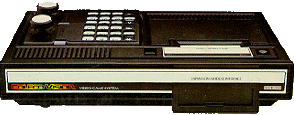
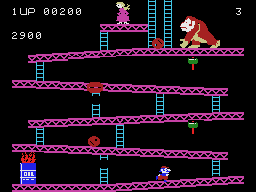
Little did I know that when my brother and I received a ColecoVision game system for Christmas when I was 12 years old, we were unknowingly initiated into the “Gamer Generation”. Growing up playing video games became an enigma that now separates us from our older siblings, parents and many other elders. But unlike most university students, I did not grow up from birth with a mouse in one hand and a cell phone in the other… this puts me in a “tweener” generation that can relate to what teaching and learning used to be like and what may be required now of educators to reach "the gamers".

Today, I rarely find (make) the time to play any video games although I do have an outdated PS1 (original PlayStation) system tucked away somewhere collecting dust. But coming from this experience, and as a former high school teacher, I found myself nodding my head in agreement at much of what Dr. John C. Beck had to say this past Tuesday at the first President’s Lecture Series event. (click here to log into to the DVSS and search for a streaming video of the event)


Here is a summary of his major points made (with some commentaries in parentheses):

John C. Beck (Capturing the Value of the Gamer Generation)


• They think, believe and learn differently
• Growing up on games creates a whole new way of thinking about the world
    - The game worlds are immersive worlds, often competitive
    - (they control things, investigate, goal seeking, emotion, decision making/problem-solving)

• Gamers are:
    - More competitive
    - Naturally global-thinking
    - More social and work better in teams
    - Willing to take risks -- attitude of “immunity to failure”
    - More confident in abilities -- prefer to be paid based on actual performance rather than a set salary
    - Believe more in luck (can be seen as them not caring and shrugging it off)
    - Flexible, don’t mind having to change (this will be helpful with the rapid changes we’re just beginning to enter)
    - They can easily go “meta”/reflective

• Boys – spatial; girls – linear (success in schools to girls, boys like games for spatial environment)
- Both want to be heroes (“that’s not fair”; kids starting charities and non-profits)
• They want to be challenged; give tough jobs/tasks
    - Natural multi-taskers
    - They want fun (to be engaged/interested/pay attention to)

• Games are basically fair (player messes up, they lose, etc.)
• “Strategy guides are good; Level Bosses are not” – that is there implied / undercurrent reality
    - Strategy guides help gamers be successful in getting through a game
    - Level bosses are something to be conquered, overcome, killed, etc. in order to move on to the next level
    - As a boss (teacher/leader), be a “strategy guide”, NOT a “level boss”

• Competitive, risky, difficult, social, global, heroic – build this type of world for them to be involved in
• All of this will change… so stay current!
- Blogs – potentially creating a world where secrets are less viable
• (Games have the potential to be a training ground for doing good; more games to promote this are forthcoming)
- Game of smiley faces clicked on while traveling over clouds – the study included approx. 130 people – it improved their self esteem
• How will relationships change in future because of this interaction between machine & human?
- Second Life – virtual world allows you to become who you want to be online
• Used to be able to buy things from others on eBay, not anymore
• “Sweat-shops” in India/China that you can contract out – i.e.-pay - to click on mouse a million times so you can gain points in these virtual worlds (Many virtual gamers are outraged by this, see “fair” item above)
• Neural pathways are created up until the age of about 13 – after that, it’s more difficult to change &/or learn (it can be done, but not as fluid or easily attained)
• Gamer generation CONTROLLED the dot.com ride – they were just living out a live video game! Like Super Mario Bros. where you collect gold pieces and once you get enough you can fly!!! – like a corporate jet!
-When the “ride” was over, they were OK… onto the next adventure…

To access an online audio recording of IT Conversations interview with John Beck, ”When Gamers Enter the Workforce” (~17 min.)

Thursday, January 19, 2006

Reflections from the Reflective Teaching Faculty Learning Community


We had an interesting and thought-provoking discussion today about student reading comprehension, literacy, images and learning styles. Here is just a sampling of the ideas shared and questions raised: (feel free to add a comment – see link below this post)


How do images play into the “literacy realm” or the “traditional literacy realm”? Are they an integrated part or treated as a separate medium?

Students are officially taught reading literacy, but we are never taught how images affect us and analyzing what is important (i.e.- media literacy – see The Center for Media Literacy

Are students more visual now than in years past? When do they adapt to ignoring images in text and why? Do we (educators) do this? Publishers?

Pictures can be considered a multilingual medium… is this the cause or effect of why we are becoming a more visual society (because our society and culture is extending beyond English & “Americanism” toward a true melting pot of cultures).

Do you have anything in your syllabus about the importance of images, graphs, charts, diagrams and their application to the textual knowledge?

Images portray emotions, often invoking a reaction or response. How does this play into the learning experience? (a picture says a 1000 words) What can be stated better with an image instead of words?

How much “peripheral learning” is being missed now since students can simply search for specific phrases or keywords in a web page or digital document rather than accidentally learning something along the way to finding the “hidden” required information within a body of text. (Similar to a long road trip to a destination vs. an airplane ride… how much peripheral learning did we acquire while in the midst of constantly repeating, “Are we there yet?!”)

What about doing something by hand versus using a computer program that does it automatically? (Ex.- only create graphs on computers or make some/one by hand too). Similar to typing 2 + 2 into a calculator and getting 5… “so that must be the right answer because that’s what the calculator says”.

In order to bring images to the forefront of students’ consciousness, consider digital or visual storytelling – similar to picture books – have students create or gather images to incorporate into a lesson or presentation. Sometimes just an image (with no text) can be more powerful than any words can convey, whether a paper copy or digital.

Have students keep a journal of their learning experiences and application attempts. Better yet, keep a journal yourself – listing your observations, insights and reflections about what’s going on in the classroom and in your student’s minds, where you want to go next or try next time teaching this lesson.

An interesting point came up about skimming to find information… How many readers of research go directly from abstract to conclusion vs. reading methodologies and results first? Why is that? (Time is an obvious factor here) Along those same lines, is the image vs. text issue with students simply a factor of time and efficiency? At what cost?

“Merely descriptive” research is often looked down upon thanks to the emergence of quantitative analysis a couple decades ago. With numbers to back up conclusions, the value of descriptive analyses has been overlooked, in both the sciences and non-sciences. Is this possibly partly due to our migration away from the narrative voice?

To sum it up, there were many reflections today that come down to the realization that there are multiple ways of knowing – for both student and teacher – and for most of what we teach, there is not only one answer or path to learning, but rather many possible routes toward that ideal common destination… wherever that may be. For your students’ sake, be sure to keep those roads open, easily located, and allow for detours as necessary!

Tuesday, January 17, 2006

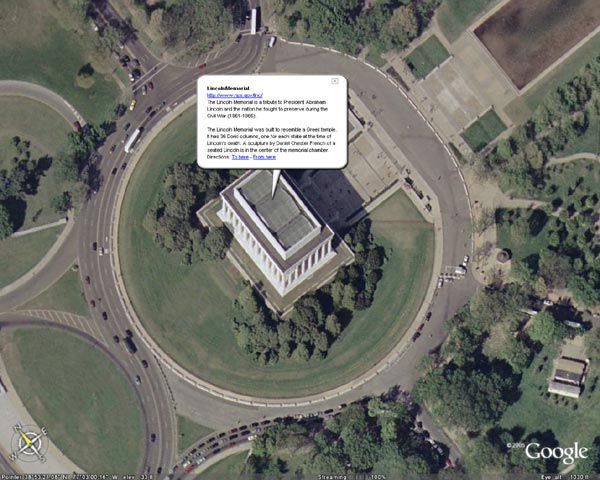
Earth Images/Maps for Your Course?


Google Earth is a free software download for PCs (WinXP) and now Macs (OS 10.4) that allow you to view actual satellite images of most locations on Earth. From Google: "You point and zoom to anyplace on the planet that you want to explore. Satellite images and local facts zoom into view. Tap into Google search to show local points of interest and facts. Zoom to a specific address to check out an apartment or hotel. View driving directions and even fly along your route."


Check it out at: http://earth.google.com/

Tuesday, December 13, 2005

CapEd - Capital U.'s Blog about Educational Blogging

Check out this "blog about blogs" by Capital University. It designed to be an online reference for blog use in education, and is a valuable resource. Add it to your list of sites you periodically review!

http://capedblog.blogspot.com/